
Climate Change Response
Climate Change Response System
Net Zero Declaration
As an energy company, SK Gas aims to meet global demands regarding climate change issues by expanding its business from existing LPG to LNG. Ultimately, SK Gas intends to contribute to opening the Net Zero era through the transition to decarbonized energy sources such as hydrogen and ammonia businesses. In line with the changing Energy Paradigm, SK Gas plans to achieve Net Zero by pursuing a low-carbon-centered Business Portfolio Transformation.
2030 Net Zero Declaration
SK Gas declared its Net Zero commitment in 2021, aiming to achieve Net Zero not only at its business sites but also across its entire value chain, encompassing all greenhouse gas emissions. The company has established ‘Net Zero Operation’ and ‘Net Zero Solution Provider’ as its climate change response strategies. Greenhouse gas reduction performance is disclosed through the Sustainability Report and the company website, with annual progress on reduction plans also made public through participation in GHG reduction initiatives such as CDP*.
- * CDP(Carbon Disclosure Project): A global project requesting information disclosure on climate change issues from companies worldwide on behalf of financial investment institutions (SK Gas first participated in 2021).
Climate Change Response Governance
In accordance with the regulations of the Board of Directors and related rules, the ESG Committee under the Board of Directors holds the oversight responsibility and authority for ESG-related issues, including climate-related risks and opportunities. The committee reviews these issues, reports them to the Board of Directors, and discusses them.
The regularly convened C-Level Consultative Body reports the discussed issues to the CEO, who holds overall responsibility for company-wide SHE (Safety, Health, and Environment). The CEO monitors ESG progress, including the status of climate change response, reviews the implementation on a quarterly basis, and reports the findings to the ESG Committee and the Board of Directors.
The dedicated ESG organization serves as the working-level organization responsible for establishing climate-related strategies and managing performance. It discusses key climate-related issues together with each executing department, and major contents are reported to and discussed within the C-Level Consultative Body.
Climate Change-Related Risks and Opportunities
The Board of Directors considers climate-related risks and opportunities across all management activities, including business strategies and financial planning. Management reports investment proposals exceeding a certain scale to the ESG Committee and obtains approval from the Board of Directors. When making investment decisions, the ESG Committee comprehensively reviews investment feasibility from a financial perspective and sustainability factors, including climate considerations, by utilizing OSS (One Stop Support) review reports and ESG checklists.
Furthermore, SK Gas considers climate-related risks and opportunities in its key decision-making processes by introducing and operating an internal carbon pricing system.
GHG Net Zero Strategy
Response Strategy
To realize its vision of ‘Sustainable Energy, Better Future,’ SK Gas is pursuing the ‘Net Zero Operation’ strategy in the short to medium term and aims to transition into a ‘Net Zero Solution Provider’ in the long term.
Firstly, the company plans to achieve Net Zero Operation across its overall operations. To this end, SK Gas is establishing climate change governance and strengthening its in-house carbon neutrality capabilities. Furthermore, it is promoting process innovation, renewable energy procurement, and energy efficiency improvements to achieve Net Zero at its business sites.
In the long term, aiming to leap forward as a Net Zero Solution Provider, SK Gas is pursuing a portfolio transition beyond LPG and LNG to the clean hydrogen business. Furthermore, it intends to strike a balance with sustainable growth by reducing Scope 3 emissions to mitigate its environmental impact across the entire value chain.
To respond to the critical issue of climate change, SK Gas will continuously strive to strengthen relevant capabilities and cooperate with various stakeholders, including customers and partners.
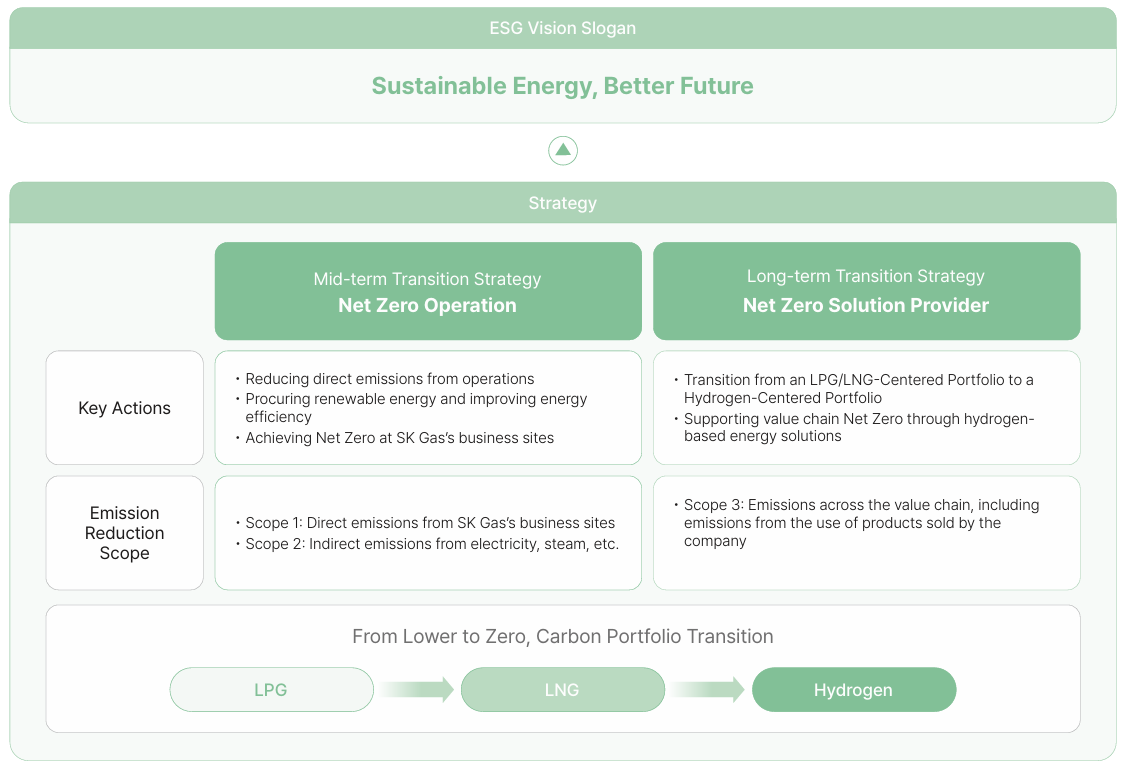
-
Vision: Sustainable Energy, Better Future
-
Strategy
-
1. Mid-term Transition Strategy: Net Zero Operation
- Key Points
- Reduce direct emissions from processes, enhance energy consumption efficiency
- Achieve Net Zero at business sites
- Scope of Reduction
- Scope 1: Direct emissions from business sites
- Scope 2: Indirect emissions from third-party energy (electricity, steam, etc.)
-
2. Long-term Transition Strategy: Net Zero Solution Provider
- Key Points
- Transition from LPG/LNG-focused portfolio to hydrogen-focused Zero Carbon portfolio
- Achieve Net Zero across the value chain
- Scope of Reduction
- Scope 3: Emissions from the consumption of products sold by the company, and emissions across the entire value chain
-
From Lower to Zero, Carbon Portfolio Transition
- LPG: Affordable/Cleaner
- LNG: Reliable
- Ammonia/Hydrogen: Just
-
2030 Net Zero Roadmap
To proactively address climate change, SK Gas has declared its goal of achieving Net Zero by 2030 and has been successfully meeting its annual greenhouse gas emission reduction targets. We continuously review the feasibility of our greenhouse gas reduction pathway, considering various factors such as national policies, the status of reduction technology development, and changes in the business environment.
In 2024, we updated our Net Zero roadmap to reflect the portfolio changes resulting from the commencement of our LNG business. Moving forward, we plan to continuously enhance the feasibility of achieving Net Zero by 2030 by comprehensively reviewing changes in the internal and external environments, as well as the costs and mitigation effects of each reduction measure and adjusting the roadmap as necessary.
Based on this reduction pathway, we aim to achieve Net Zero by 2030. Although greenhouse gas emissions may partially increase during the reduction period due to the commencement of new businesses, we plan to reduce emissions through measures such as expanding the use of seawater heat exchangers and procuring renewable energy through Power Purchase Agreements (PPAs). This reduction pathway was established based on currently commercially available technologies, and we judge that the implementation of each reduction measure will also contribute to improving corporate value. While we will continue our sincere reduction efforts to achieve our goals, we also plan to enhance feasibility by continuously reviewing and adjusting our targets and implementation pathways in response to changes in the internal and external environments.
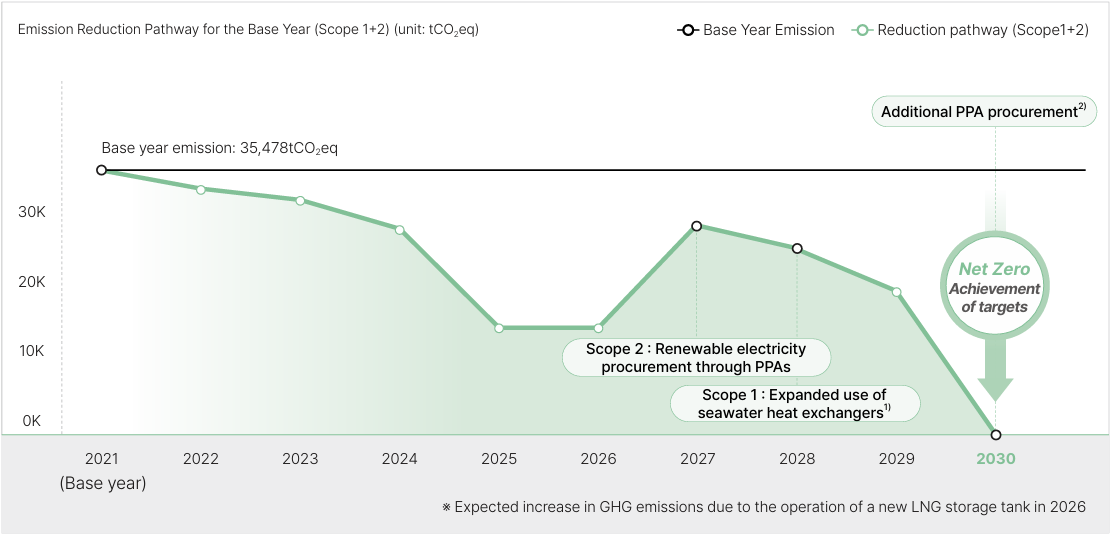
Baseline Year Emission Volume: 35,478 tCO2eq
- 1. LPG Portfolio Transition
- 2. Seawater Heat Exchanger
- 3. First PPA Procurement
- 4. Electric Heater Adoption
- 5. Second PPA Procurement
- 2030 Net Zero Goal (2030)
Baseline Year Emissions (SBTi Standard Reduction), Net Zero Goal, Actual Emissions (2021-2023)
- 1)Expansion of seawater heat exchanger usage is underway in design, permitting, and coordination with relevant agencies, with potential changes in implementation timing and reduction effects.
- 2)Additional PPA contracts are required for procurement, with actual implementation timing and reduction effects subject to change based on progress.
GHG Reduction Activities
To enhance corporate value in the process of pursuing our Net Zero goals, SK Gas selects greenhouse gas reduction measures after comprehensively reviewing technical feasibility as well as financial costs and benefits.
For Fired Heaters, which account for 99% of our Scope 1 emissions, we have decided to mitigate emissions by installing seawater heat exchangers that significantly reduce energy consumption itself. For electricity consumption, which accounts for the vast majority of our Scope 2 emissions, we have established a plan to replace it with renewable energy power and are implementing it according to an annual schedule.
For Category 1, 10, and 11 emissions, which account for over 75% of our Scope 3 emissions, we aim to achieve Net Zero for Scope 3 emissions by 2050, with the long-term goal of supplying clean hydrogen feedstocks. Furthermore, we utilize 'Haenggarae,' a social value practice application, to raise members' awareness of climate change issues and encourage them to contribute to greenhouse gas reduction. Members can earn SV (Social Value) Rewards through activities such as taking the stairs instead of the elevator, walking short distances, reducing food waste, and using mugs or tumblers. These SV Rewards can be donated or used to purchase goods from social enterprises. Detailed information is disclosed through our Sustainability Report, which is published annually.
GHG Performance
Greenhouse Gas Emission Metrics
SK Gas calculates its Scope 1 and 2 emissions in accordance with the Ministry of Environment's guidelines on reporting and verification of emissions under the Korea Emissions Trading Scheme (KETS) and utilizes the basic emission factors from the 2006 IPCC National Greenhouse Gas Inventory Guidelines, as well as the country-specific calorific values and emission factors for each fuel as notified by the Ministry of Environment. Additionally, SK Gas calculates its Scope 3 emissions for all relevant and significant Scope 3 categories based on the Greenhouse Gas Protocol Corporate Value Chain (Scope 3) Accounting and Reporting Standard (2011).